


Daniel SandfordUK correspondent

 Dan Kitwood/Getty Images
The UK’s asylum system is affected by inefficiencies, “wasted public funds” and a succession of “short-term, reactive” government policies that have moved problems elsewhere, the National Audit Office (NAO) has said.
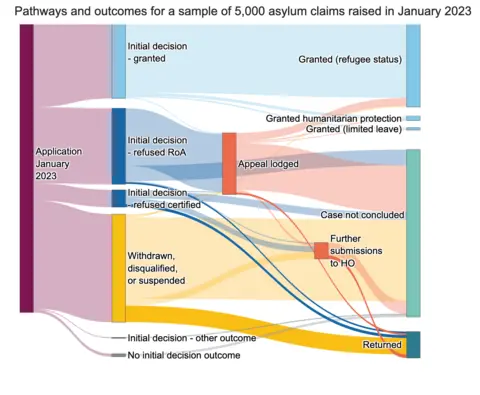
As part of its analysis, the spending watchdog looked at a sample of 5,000 asylum claims lodged almost three years ago, in January 2023.
Since then, 35% (1,619) of those asylum seekers had been given some sort of protection such as refugee status, and 9% (452) had been removed from the country. But 56% (2,812) still did not have a final outcome in their case.
The Home Office welcomed the analysis, which it said supported “the case for fundamental reform of the asylum system”.
Most of the cases in the remaining group (2,021 out of the 2,812) remained in a sort of “limbo”, with no appeal lodged.
The NAO’s chief analyst, Ruth Kelly, told reporters: “They’ve had their claim refused, but they’re staying in the system with their case unresolved, and that’s because of the difficulties in removal.”
A shortage of other types of accommodation means that large numbers of asylum seekers whose cases are not closed are being housed in hotels. The cost of accommodation in 2024-25 was £2.7bn.
Enver Solomon, the chief executive of Refugee Council, said of the January 2023 analysis: “The NAO’s finding that more than half of people who applied for asylum almost three years ago still don’t have an outcome is shocking.”
He said the report mirrors what the Refugee Council’s front-line services see every day, “an asylum system that is simply not functioning, where people wait months or even years for a decision… and costs keep rising”.
The NAO’s report criticises how successive governments have dealt with the current surge in small boats crossings that began in 2018.
“Interventions have tended to be reactive and focused on fixing an urgent problem in one part of the system only, such as intake or initial decisions, without a clear view of the effects on other parts,” the report says.
“Increases in speed of processing have sometimes come at the expense of the quality of decisions, and improvements in one area have shunted problems elsewhere.”
The NAO gave the example of former prime minister Rishi Sunak’s drive to clear the legacy asylum backlog in 2023, which then shifted pressure onto the appeals stage, simply creating another backlog in the courts.
Shortage of judges
Ruth Kelly said one of the most critical factors now was a shortage of specialist immigration judges to hear appeals.
“There’s a severe capacity shortage with judges,” she said. “And judges told us there are poor incentives for working in the immigration and asylum tribunals… because of the taxing and the complex nature of the work, and also because of negative media attention, which makes it harder to recruit judges.”
The NAO said it would be looking for evidence that the government was now moving away from “short-term, reactive fixes” towards a “sustainable whole-system approach”.
It said the current lengthy delays in the system “erode public confidence in the system’s fairness and effectiveness”.
The NAO also found that it was impossible to track individual cases through the whole asylum process because there is no “unique asylum case identifier” shared by Home Office, court service and local authority computer systems.
The report says that because the asylum applications are subject to fluctuating demand with significant peaks, it was important to build a flexible and resilient system that can respond to increases and decreases in demand.
Ruth Kelly, the NAO analyst, said the government needed to avoid reverting to “that pattern of counter-productive quick fixes that we have seen in the past”.
A Home Office spokesperson said: “The home secretary recently announced the most sweeping changes to the asylum system in a generation to deal with the problems outlined in this report.
“We are already making progress – with nearly 50,000 people with no right to be here removed, a 63% rise in illegal working arrests and over 21,000 small boat crossing attempts prevented so far this year.
“Our new reforms will restore order and control, remove the incentives which draw people to come to the UK illegally and increase removals of those with no right to be here.”